
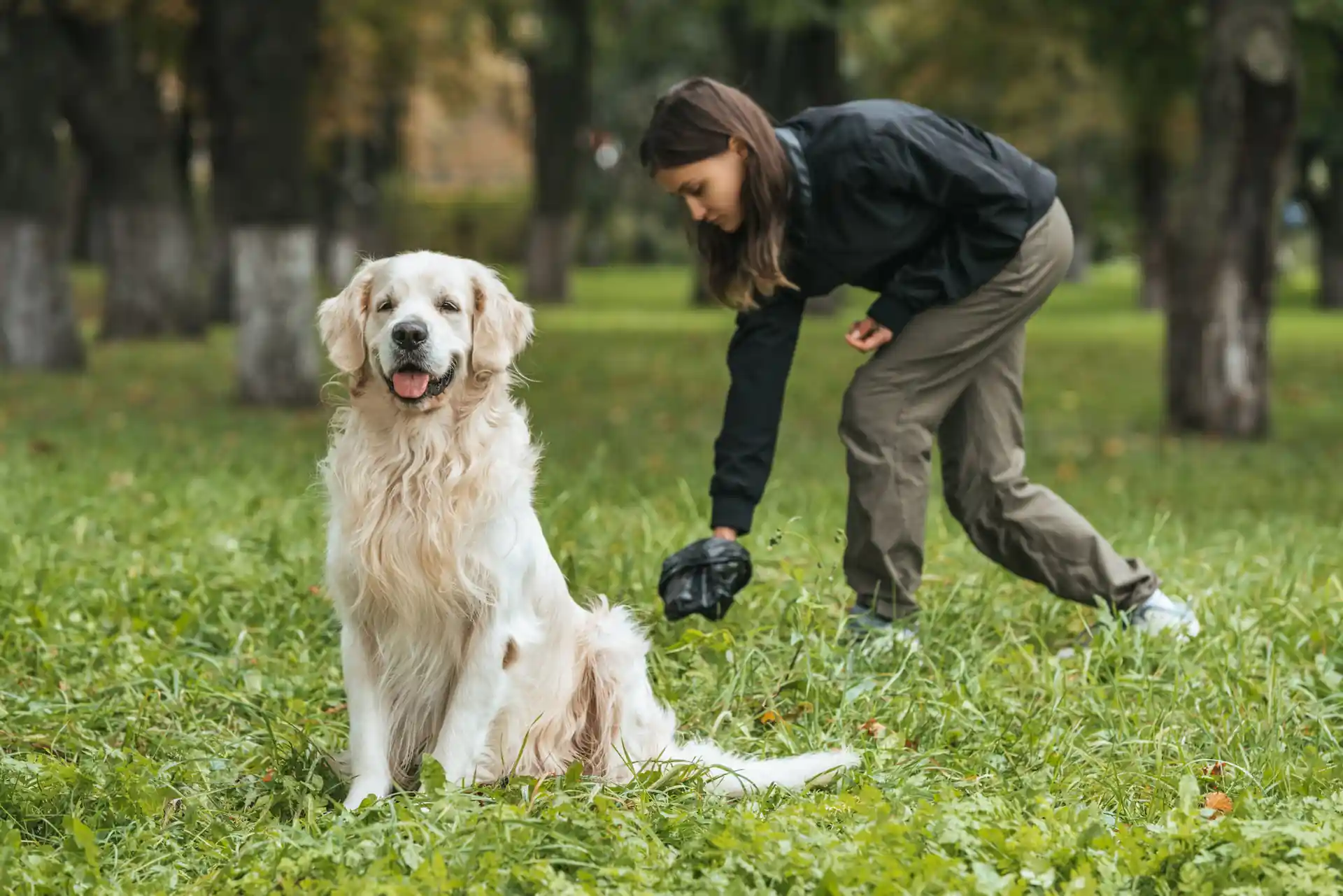
- Professional scoopers double-bag the waste and send it out with regular household trash, ending at a lined municipal landfill.
- Dog waste is not fertilizer. It is acidic, packed with nitrogen, and can carry parasites that survive in soil for years.
- Composting, flushing, and "biodegradable" bags all sound greener than they actually are.
Pet waste removal services dispose of waste by double-bagging it and sending it out with regular trash, which means it ends up in the same lined municipal landfill as the rest of your garbage.
How do pet waste removal services dispose of waste? (Step by step)
Every service starts the same way. A technician works through the entire yard, not just the obvious spots, and collects everything into a bag.
That bag goes inside a second bag, and both get knotted shut.
Double-bagging is not overkill, it locks in odor, prevents leaks, and protects everyone who handles the trash afterward, including the collection crew.
From there, the industry splits into two camps:
- Most companies place the sealed bags in the client's own outdoor trash bin, where they ride along with the regular garbage pickup.
- Others load the bags onto the truck and dispose of them off site through a commercial waste service.
Either way, the destination is the same, a lined municipal landfill engineered to contain household waste safely.
That is the honest answer to how do pet waste removal services dispose of waste: carefully, legally, and through the same waste stream your household already uses.
Is it even legal to throw dog waste in the trash?
Residential dog waste is treated as ordinary household garbage, not hazardous waste. Permits, manifests, and special handling are reserved for things like industrial byproducts and medical waste; a bag of dog waste rides the same legal lane as everything else in your bin, so professional services need no special license to handle or transport it.
What the law does care about, almost everywhere, is waste that never gets picked up.
Most cities and suburbs have scoop ordinances with real teeth, with fines that commonly start around $50 and can climb into the hundreds in some towns. The law's concern is that waste gets picked up and contained. Bagged and binned is exactly what compliance looks like.
Why not compost it or flush it?
Because dog waste is not fertilizer, no matter how natural it seems.
Dogs eat protein-heavy diets, so their waste comes out acidic and loaded with concentrated nitrogen. That is the same chemistry as over-applying fertilizer, which is why those yellow burn spots appear in the grass.
It also carries pathogens that cow or horse manure does not.
Composting sounds better than it works. Killing the parasites in dog waste requires a sustained temperature around 140 degrees, which backyard compost piles almost never reach.
Most municipal compost programs refuse pet waste for the same reason: one contaminated batch ruins the pile.
The truth about "biodegradable" bags
Here is the part most companies skip, a biodegradable bag does almost nothing once it reaches a landfill.
Modern landfills are compacted, dry, and sealed off from oxygen, conditions that stall decomposition for nearly everything, bags included.
The Federal Trade Commission made this point formally in 2015, warning 20 dog waste bag makers that their "biodegradable" and "compostable" claims could be deceptive, since most bags end up in landfills where little to nothing breaks down.
What actually matters is containment. A sturdy, leak-proof bag, doubled and knotted, does more for your neighborhood and the people handling your trash than any label on the box.
Why careful disposal matters
Waste left on the lawn does not fade away, rain breaks it down and carries it into storm drains and local waterways.
A single gram of dog waste can carry upwards of 23 million fecal coliform bacteria, and the CDC notes that roundworm eggs can survive in soil for years once they are there. This is why the EPA has classified pet waste as a nonpoint-source pollutant since 1991, in the same category as oil and pesticide runoff.
The volume adds up faster than you would think. An average dog produces about three quarters of a pound of waste per day, roughly 275 pounds a year. Multiply that across a neighborhood of dogs and proper disposal stops being a nicety and starts being a public health habit.
How BarkScoop handles it
We believe you should know exactly what happens in your own back yard. Every cleanup covers the whole yard, including under bushes and along fence lines. Everything we collect is double-bagged, knotted, and hauled away with us, so nothing is left sitting in your outdoor bin.
Between yards, our tools and shoes get a kennel-grade disinfectant, so nothing follows us to yours.
If scooping is the chore you would happily never think about again, get an instant quote online. No phone call required or contract.
Keep reading
 Hiring a Pro
What is a pooper scooper service?
A quick, plain-English guide to what a pooper scooper service is, how cleanups work, how often they happen, and what to look for b
Read the story Hiring a Pro
How Much Does It Cost to Have Someone Clean Up Dog Poop?
Wondering what a pooper scooper service costs? Here's the breakdown.
Read the story